
Most people buy apple cider vinegar for salad dressings or morning tonics — then the bottle sits in the pantry for months. That’s a waste of one of the hardest-working liquids in your kitchen. Beyond cooking, ACV is a natural cleaner, deodorizer, produce wash, and pest trap that can replace a shelf full of chemical products.
In this guide, you’ll discover 10 creative kitchen uses of apple cider vinegar outside cooking — from streak-free glass and descaled kettles to fresher produce and a fruit-fly trap that actually works. Each use includes the exact method, so you can start today with the bottle you already own.
Table of Contents
- 1. Streak-Free Glass and Window Cleaner
- 2. Descale Your Kettle and Coffee Maker
- 3. Wash Pesticides Off Fruits and Vegetables
- 4. Deodorize Your Kitchen Naturally
- 5. Sanitize Cutting Boards and Wooden Utensils
- 6. Build a Fruit Fly Trap That Works
- 7. Freshen and Clear Slow Drains
- 8. Steam-Clean Your Microwave
- 9. Keep Cut Flowers and Herbs Fresh Longer
- 10. The Perfect Poached Egg Trick
- Safety Notes for Kitchen Use
- Frequently Asked Questions
1. Streak-Free Glass and Window Cleaner
ACV’s acidity dissolves mineral deposits and grease without the chemical fumes of commercial glass cleaners. Mix equal parts ACV and water in a spray bottle, spritz onto glass or mirrors, and wipe with a microfiber cloth or newspaper for a streak-free shine.
It works on stovetop glass, appliance fronts, and even the inside of oven doors. The vinegar smell fades within minutes as it evaporates.
2. Descale Your Kettle and Coffee Maker
Hard-water scale makes kettles noisy and coffee taste flat. Fill your kettle with half ACV, half water, bring to a boil, let it sit 20 minutes, then rinse thoroughly. For coffee makers, run a brew cycle with the same mixture, then two cycles of plain water to flush the taste.
3. Wash Pesticides Off Fruits and Vegetables
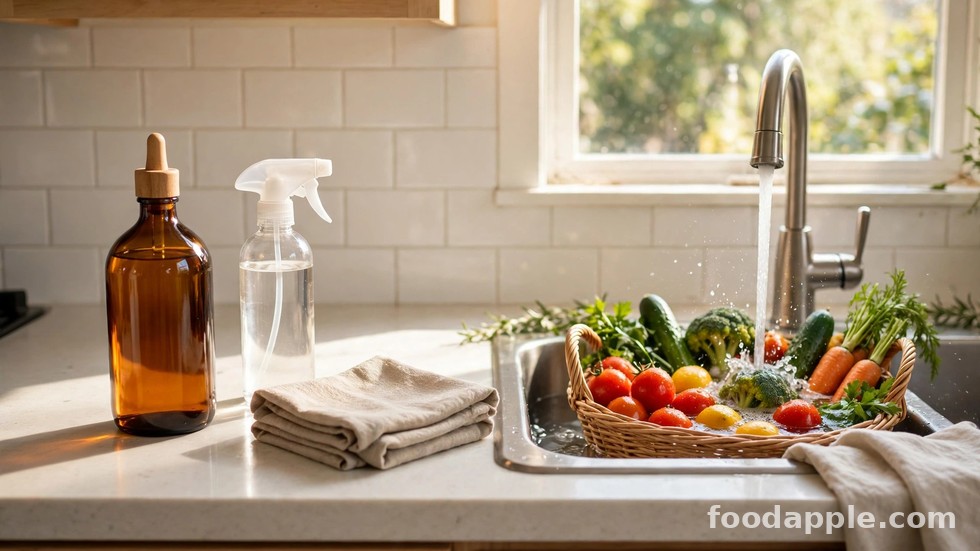
Studies show a vinegar wash can remove significantly more pesticide residue than water alone. Fill a large bowl with water and add 1 cup of ACV per gallon, soak produce for 10–15 minutes, then rinse. This works especially well for apples, grapes, berries, and leafy greens with lots of surface area.
4. Deodorize Your Kitchen Naturally
Simmer a small bowl of undiluted ACV on the stove for 15–20 minutes to neutralize lingering cooking odors — fried fish, burnt toast, strong spices. You can also leave an open bowl of ACV in the fridge overnight to absorb stale smells, or wipe down trash cans with diluted ACV.
5. Sanitize Cutting Boards and Wooden Utensils
After washing, spray wooden cutting boards with undiluted ACV and let it sit for 10 minutes before rinsing. The acidity inhibits common kitchen bacteria. For extra power, follow with a rub of half a lemon and coarse salt to lift stains and odors from the wood grain.
6. Build a Fruit Fly Trap That Works
Fruit flies can’t resist fermenting fruit smells. Pour half an inch of ACV into a small glass, add a drop of dish soap (it breaks the surface tension so flies sink), and cover with plastic wrap poked with tiny holes. Place near your fruit bowl — within a day or two, the trap fills up.
7. Freshen and Clear Slow Drains
For sluggish or smelly drains, pour half a cup of baking soda down the drain, followed by one cup of ACV. Let the fizzing reaction work for 15 minutes, then flush with a kettle of boiling water. It won’t fix a serious clog, but it clears grease buildup and odors.
8. Steam-Clean Your Microwave
Combine 1 cup water and 2 tablespoons ACV in a microwave-safe bowl. Heat on high for 5 minutes, then let it stand — door closed — for another 3 minutes. The steam loosens stuck-on splatters so they wipe away with a single cloth, no scrubbing needed.
9. Keep Cut Flowers and Herbs Fresh Longer
Add 2 tablespoons of ACV and 1 teaspoon of sugar per quart of vase water. The vinegar inhibits the bacteria that clog stems, while the sugar feeds the blooms. Change the solution every few days and your flowers can last several days longer than in plain water.
10. The Perfect Poached Egg Trick
Okay, this one is technically cooking — but it’s a technique, not a recipe. Add a teaspoon of ACV to simmering poaching water. The acid helps the egg white proteins set faster, so you get tight, neat poached eggs instead of wispy strands. The vinegar taste is undetectable in the finished egg.
Safety Notes for Kitchen Use
- Never mix vinegar with bleach — it creates toxic chlorine gas
- Avoid on natural stone — marble, granite, and travertine etch under acid; use pH-neutral cleaners there
- Don’t use on cast iron or aluminum regularly — acid strips seasoning and can pit aluminum
- Label your spray bottles so cleaning mixtures aren’t confused with food prep
- Use cheap filtered ACV for cleaning — save the raw, unfiltered bottle with the mother for drinking
Frequently Asked Questions
Can I use ACV instead of white vinegar for cleaning?
Mostly yes, with one caveat: ACV’s amber color can lightly stain light fabrics or porous white surfaces. For laundry or white grout, stick with distilled white vinegar. For glass, descaling, and deodorizing, ACV works just as well.
Does ACV actually kill germs?
ACV’s acetic acid inhibits many common bacteria and some viruses on surfaces, making it a decent everyday cleaner. However, it is not a registered disinfectant and won’t kill everything — use proper disinfectants for raw meat contamination or illness.
Will the vinegar smell linger?
No. The vinegar odor evaporates as it dries, usually within 15–30 minutes. Good ventilation speeds this up. If a surface still smells after drying, you used too much — wipe with a damp cloth.
Is it wasteful to use expensive raw ACV for cleaning?
A little. Cleaning doesn’t need the mother or live cultures, so buy an inexpensive filtered ACV (or distilled white vinegar) for household tasks and reserve the raw, unfiltered bottle for health and food uses.