
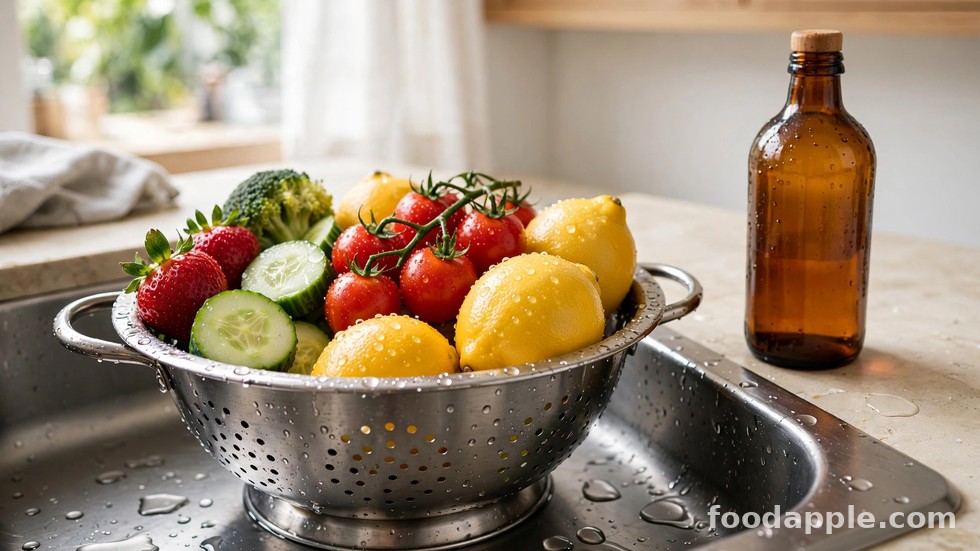
You rinse your apples under the tap — but is plain water really enough to wash away pesticide residues? For many fruits and vegetables: not quite. Pesticides are designed to cling through rain and handling, so a quick rinse leaves residues behind. One of the most effective produce washes is already in your pantry: apple cider vinegar. Here is how to mix an ACV wash, which produce benefits most, what the science says, and its limits.
Table of Contents
- Why Plain Water Falls Short
- How an ACV Wash Actually Works
- The ACV Produce Wash Recipe
- Step-by-Step: Washing Different Produce
- Which Produce Needs It Most
- What ACV Cannot Do: Know the Limits
- Frequently Asked Questions
Why Plain Water Falls Short
Modern pesticides fall into two broad groups: contact pesticides, which sit on the surface of the fruit, and systemic pesticides, which are absorbed into the plant’s tissue as it grows. A rinse under the tap removes loose dirt and some surface residues, but many pesticide formulations include sticking agents and waxes specifically designed to resist being washed off by rain — your kitchen faucet is not much more persuasive than a rainstorm.
Studies find plain water removes only a fraction of surface residues — often less than half. That does not make conventional produce dangerous (regulatory limits include large safety margins), but upgrading your wash method is a simple, evidence-backed way to minimize exposure.
How an ACV Wash Actually Works
An acidic soak works through simple chemistry. Many pesticide residues break down more readily in acidic conditions, and the mild acidity of vinegar (pH 2–3) helps dissolve waxy coatings that trap residues on the skin. The soak also gives residues time to detach, while gentle agitation and a final rinse carry them away.
Research on vinegar-based washes is encouraging: soaking produce in a vinegar-water solution for 10–20 minutes removes significantly more residue than water alone — some studies report 70–90% removal of certain surface residues. Vinegar soaks also reduce bacterial contamination, a double benefit. ACV works just as well as white vinegar here.
The ACV Produce Wash Recipe
You only need two ingredients and a large bowl or a clean sink basin.
- Mix: Combine 1 part apple cider vinegar with 3–4 parts cool water — for example, 1 cup of ACV to 3–4 cups of water, scaled up for a sinkful.
- Soak: Submerge the produce fully for 10–15 minutes. Swish gently a few times during the soak.
- Scrub (for firm produce): Use a soft vegetable brush on apples, cucumbers, potatoes, and carrots to loosen residues from crevices and the stem end.
- Rinse thoroughly: Rinse under cool running water to wash away loosened residues and any vinegar taste.
- Dry: Pat dry with a clean towel or air-dry on a rack — dry produce stores longer and stays crisper.
Optional boost: Adding 1 tablespoon of baking soda per quart of water alongside the vinegar creates a brief fizzing action that some studies suggest improves residue removal further. Add the baking soda to the water first, then the vinegar, and soak as usual.
Step-by-Step: Washing Different Produce
Firm Fruits: Apples, Pears, Grapes, Citrus
Soak for the full 15 minutes, then scrub gently — especially around the stem cavity of apples, where residues and wax collect. For grapes, soak the whole cluster and swish well, since residues hide where grapes touch.
Soft Fruits: Berries, Stone Fruits
Berries are delicate — shorten the soak to 5–10 minutes so they do not go mushy or absorb vinegar flavor. Strawberries, blueberries, and raspberries benefit enormously since they are eaten unpeeled and rank high on residue lists. Drain gently in a colander, rinse lightly, and dry thoroughly; damp berries mold fast.
Leafy Greens and Herbs
Submerge lettuce, spinach, kale, and herbs in the wash, swish vigorously, and let soak for 5–10 minutes. Leafy greens have huge surface areas that trap both residues and grit. Lift the greens out of the water (rather than pouring through a colander) so loosened dirt stays behind in the bowl. Spin or pat very dry before storing.
Root Vegetables
Potatoes, carrots, and beets grow in treated soil, so start by scrubbing off visible dirt under running water, then give them the 15-minute ACV soak with a firm brushing. Peeling removes the most residue of all — but if you want to keep the nutrient-rich skins, the vinegar wash plus scrubbing is your best alternative.
Which Produce Needs It Most
If washing everything feels like too much, prioritize thin-skinned produce eaten whole: strawberries, spinach, kale, grapes, peaches, apples, bell peppers, cherries, and blueberries consistently show the highest residues. These deserve the full soak-and-scrub every time.
Lower priority are thick-skinned or peeled produce — avocados, bananas, pineapples, melons, onions, and sweet corn — where the inedible peel already blocks most residues. A quick rinse is plenty for these. Focus your effort where it actually reduces exposure.
What ACV Cannot Do: Know the Limits
Honesty matters here: no wash, vinegar-based or otherwise, removes systemic pesticides that the plant absorbed into its flesh while growing. Those are inside the tissue, not on it. If minimizing total pesticide exposure is a top priority, the only reliable step beyond washing is choosing organic or low-spray produce for the highest-residue items and peeling conventional produce when practical.
Keep perspective: the health benefits of eating plenty of fruits and vegetables far outweigh the risks of trace residues. An ACV wash is a sensible precaution — not a reason to fear produce or eat less of it.
Frequently Asked Questions
Will my fruit taste like vinegar after soaking?
Not if you rinse well. A thorough rinse under cool running water removes the vinegar completely. If you are sensitive to the smell, shorten the soak to 10 minutes for delicate fruits — and remember berries should only soak for 5–10 minutes anyway.
Is ACV better than white vinegar for washing produce?
They work about equally well — the active factor is the acetic acid, which both contain at similar concentrations. White vinegar is cheaper for big sinkfuls, while ACV is a fine choice if it is what you have. Avoid expensive raw ACV with the mother for this job; basic ACV does the same work for less money.
Can I reuse the vinegar wash water?
It is best to make it fresh each time. Once used, the water contains the very residues, dirt, and bacteria you just washed off — reusing it would redeposit them onto the next batch. A fresh mix takes 30 seconds and works far better.
Does washing remove wax coatings from apples?
Partially. The mild acid plus scrubbing helps break down wax coatings where residues get trapped — the mechanical brushing matters as much as the vinegar.
Should I wash organic produce with vinegar too?
Yes — organic produce can still carry approved natural pesticides, handling contamination, and bacteria from the supply chain. A quick vinegar soak and rinse is worthwhile for organic berries, greens, and anything eaten raw, though you can skip the long soak.