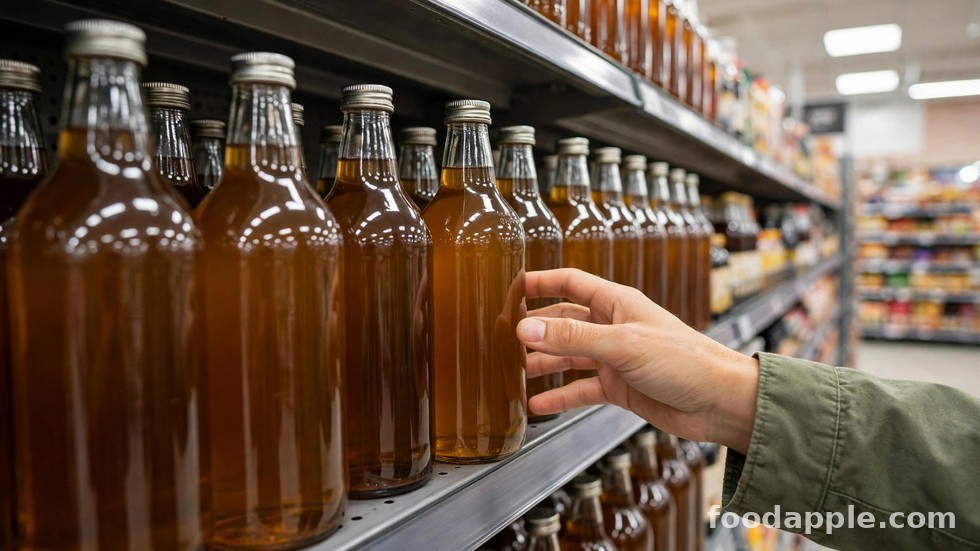
Walk down the vinegar aisle and you’ll face a wall of choices: raw, organic, filtered, flavored, bargain jugs, premium bottles. Prices range from a few dollars to twenty — and the labels all shout “best.” But when it comes to apple cider vinegar, not all bottles are created equal, and the right choice depends on what you’re using it for.
This guide cuts through the marketing. You’ll learn the 7 things that actually matter on an ACV label, the difference between raw and filtered, which certifications are worth paying for, and how to spot low-quality or fake products — so every dollar you spend buys real quality.
Table of Contents
- Raw vs Filtered: The Biggest Decision
- The 7-Point Label Checklist
- Is Organic ACV Worth the Extra Cost?
- Acidity Percentage: Why 5% Matters
- Packaging: Glass vs Plastic
- Red Flags: How to Spot Low-Quality ACV
- Matching the Bottle to Your Use Case
- Where to Buy Quality ACV
- Frequently Asked Questions
Raw vs Filtered: The Biggest Decision
Raw, unfiltered ACV contains the “mother” — strands of beneficial bacteria, enzymes, and proteins that form during natural fermentation. It’s cloudy, with sediment at the bottom, and it’s the type used in most health research and traditional remedies.
Filtered, pasteurized ACV is clear and amber, with the mother removed and the vinegar heat-treated for shelf stability. It tastes cleaner and milder, costs less, and works perfectly for cooking, pickling, and cleaning — where live cultures don’t matter.
The verdict: for drinking, tonics, and health uses, choose raw and unfiltered. For cooking and household tasks, filtered is fine and cheaper.
The 7-Point Label Checklist
- 1. “Raw” and “unfiltered” — confirms the mother is intact (for health uses)
- 2. “With the mother” — look for visible cloudiness or sediment in the bottle
- 3. “Organic” — means the apples were grown without synthetic pesticides
- 4. “5% acidity” — the standard strength for real vinegar; lower means diluted
- 5. Ingredients list — should read simply “organic apples” or “apple cider vinegar” — nothing else
- 6. “Unpasteurized” — heat treatment kills the beneficial cultures
- 7. No added flavors or colors — caramel color or “apple flavor” signals a processed product
Is Organic ACV Worth the Extra Cost?
Usually, yes — and the price gap is small. Organic certification guarantees the apples were grown without synthetic pesticides or fertilizers, which matters because vinegar is a concentrated apple product. Non-organic ACV can carry pesticide residues from conventionally grown apples.
That said, organic doesn’t guarantee the vinegar is raw. You can find organic but filtered/pasteurized ACV — fine for cooking, but missing the mother. For the best bottle, look for organic + raw + unfiltered together.
Acidity Percentage: Why 5% Matters
Authentic vinegar contains at least 4–5% acetic acid — this is actually a legal definition of vinegar in many countries. If a label shows lower acidity or doesn’t state it at all, the product may be diluted or imitation. Always check: 5% is the gold standard for real apple cider vinegar.
Packaging: Glass vs Plastic
Glass bottles are superior for ACV. Vinegar’s acidity can slowly interact with plastic over months of storage, and glass better preserves flavor. Premium brands almost always use glass; bargain vinegar in plastic jugs is acceptable for cleaning but less ideal for daily drinking. Also check that the cap seals well — a loose cap lets in oxygen that dulls flavor.
Red Flags: How to Spot Low-Quality ACV
- Crystal-clear “raw” claims — real raw ACV is cloudy; clarity means it’s filtered
- Added caramel color — used to fake the amber look of real cider vinegar
- “Apple-flavored” distilled vinegar — white vinegar with flavoring, not fermented from apples
- No acidity listed — legitimate producers state 5% proudly
- Suspiciously cheap — real fermentation takes weeks; rock-bottom prices suggest shortcuts
- Harsh chemical smell instead of a clean apple-tart aroma
Matching the Bottle to Your Use Case
Daily health tonic: organic, raw, unfiltered, with the mother, glass bottle. Cooking and dressings: any real 5%-acidity ACV; raw is a nice bonus for flavor depth. Pickling and preserving: filtered 5% acidity for clarity and consistent results. Cleaning and household: the cheapest filtered ACV (or distilled white vinegar) you can find.
Smart shoppers keep two bottles: a premium raw organic for drinking, and a budget filtered jug for everything else.
Where to Buy Quality ACV
Good ACV is widely available — you don’t need a specialty store. Supermarkets now stock organic raw brands in the vinegar or natural-foods aisle; health food stores offer the widest selection, including small-batch artisanal producers. Online retailers are convenient for bulk buying, but check seller ratings since bottles can sit in hot warehouses.
When buying, inspect the bottle: raw ACV should look cloudy with visible sediment, the cap should be sealed tight, and the label should state 5% acidity. Buying larger bottles (32 oz or gallon) cuts the per-ounce cost significantly if you use ACV daily. Store unopened bottles in a cool pantry — they keep for years, so stocking up during sales is perfectly safe.
Frequently Asked Questions
Which type of ACV is healthiest?
Organic, raw, unfiltered ACV with the mother in a glass bottle. It retains beneficial bacteria, enzymes, and apple polyphenols that pasteurization and filtering remove. Check for 5% acidity on the label.
Does expensive ACV work better than cheap ACV?
For health uses, quality markers (raw, organic, mother intact) matter more than price — and mid-priced organic raw brands perform just as well as luxury ones. Ultra-cheap clear vinegar is fine for cleaning but not ideal for daily drinking.
How do I know if ACV is truly raw?
Look for the words “raw” and “unpasteurized” on the label, plus visible cloudiness or sediment (the mother) in the bottle. Truly raw ACV is never crystal clear. If in doubt, shake the bottle — the mother should swirl visibly.
Is store-brand ACV okay?
Many store brands now offer perfectly good organic raw ACV at lower prices — check the label for the same markers (raw, unfiltered, 5% acidity, organic). The brand name matters far less than what’s actually in the bottle.
1 thought on “How to Choose the Best Store-Bought Apple Cider Vinegar Brand”